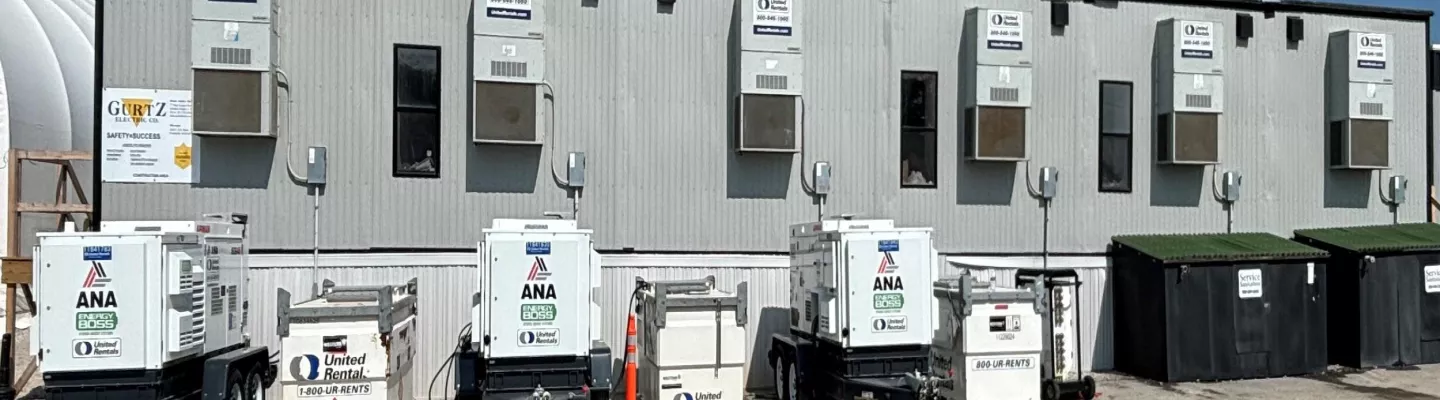
Chances are your generator is oversized for the job and you’re spending far too much on fuel.
Article Updated on: August 5, 2026
Most off-grid or remote jobsites rely on portable generators for temporary power. When it comes to generator sizing, contractors very commonly make a costly mistake: They oversize their generators by as much as 50% to 75%. Regularly running a generator at loads well below the maximum rated load is not only bad for the generator, it also ratchets up a project’s fuel spend, not to mention its greenhouse gas emissions.
Another common problem: Contractors often run generators 24/7 when they don’t need to.
The problem with sizing generators for peak loads
When the load is variable and you size a generator based on the maximum power required, the generator runs significantly underloaded most of the time and runs when it isn’t needed. A few examples:
- A crane requires a surge of power when it lifts or moves a load, but in between picks, only a tiny amount of power is needed, enough to run the lights and the cab’s heating or cooling system.
- Welders weld only intermittently; when they aren’t welding, the generator is running for nothing.
- Generators used to power jobsite trailers are often sized based on the maximum requirements of the breaker panel, but typical loads are much smaller, and they tend to dip dramatically at night.
The high costs of oversizing and over-running
The larger the generator, the more fuel it consumes and the higher the rental cost. In addition, running a generator underloaded leads to inefficient operation and mechanical issues. Wet stacking may cause the generator to fail unexpectedly, resulting in expensive downtime and a service call.
Keeping a generator running 24/7 also drives costs higher than they need to be. It gobbles fuel, causes excessive wear and tear on the generator and shortens its lifespan. What’s more, if you rent a generator and run it nonstop, you’ll pay a triple shift rate.
How a BESS handles variable loads
Downsizing a generator while handling variable loads is possible with the help of a BESS. Best practice is to size the generator for average loads and size the BESS to support peak loads.
A BESS stores energy in high-density batteries and features inverters and load-sensing technology. The battery powers the load until it needs charging, at which point it automatically turns on the generator. Once the battery is charged, it shuts off the generator. During peak loads, the battery supplements the generator power.
Generator-only vs. generator + BESS comparison table
Generator only (sized for peak load) | Generator + BESS rental (sized for average load) | |
|---|---|---|
Runtime | Often 24 hours/day | As low as 2.5 hours/day in the case studies cited above |
Fuel use | Highest — generator runs continuously at partial load | Reduced up to ~77–91% in the case studies cited above |
Noise | Continuous | Limited to recharge periods |
Rental cost | May trigger triple-shift rate if run nonstop | Lower shift rate as generator use drops |
Sizing example
A quick way to think about sizing: if your breaker panel is rated for a 300kVA peak load but your typical draw is closer to 100–125kVA, that gap is exactly what a BESS is built to cover — the generator can be downsized toward the average load, and the battery absorbs the peaks. That's the same logic behind the tower crane example below, where a 300kVA generator was downsized to 125kVA once a BESS took over peak coverage.
Measurable benefits of using a BESS
Contractors have begun reaping massive benefits from pairing a generator with a BESS.
For instance, a large general contractor was running a 300kVA generator to power an 8-ton tower crane. After renting a Termaco TREE 500kW BESS from United Rentals, they were able to downsize to a 125kVA generator. Generator run time dropped from 24 hours to 2.5 hours a day—a 91% reduction. That drop resulted in an estimated fuel use and emissions reduction of 77%.
Another large contracting firm used a POWRBANK unit paired with a 70kVA generator to power three jobsite trailers. The generator ran an average of 2.5 hours a day. By downsizing their standard generator and reducing run time, the contractor saved more than $12,000 a month in fuel and rental rate (going from triple shift to single shift) and reduced CO2 emissions by nearly 34,000kg.
Reducing carbon emissions helps contractors meet project sustainability goals and provides a cleaner, healthier jobsite for workers. Shorter generator run times also reduce noise, another benefit to workers and any nearby residents or office workers.
When to consider a BESS
If you’re powering highly variable loads or running a generator 24 hours a day on a long-term project, you should consider renting a BESS. Reducing your dependence on portable generators can increase the reliability of your temporary power supply while cutting costs and shrinking your carbon footprint.
The Power & HVAC team at United Rentals has the knowledge and experience to help you accurately assess your load requirements and guide you to a hybrid power system suitable to meet your temporary power needs.
 Facebook
 X
 Linkedin
 Email
 Print
 Copy Link
 RSS Feed