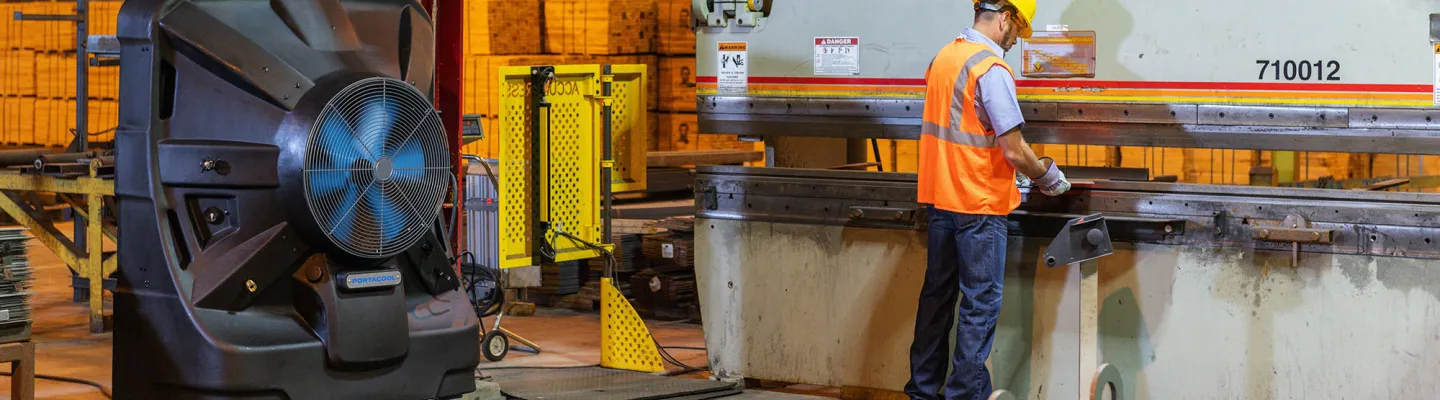
Energy-efficient evaporative cooling units excel in hot, dry climates and work both indoors and outdoors.
Article Updated on: October 19, 2026
Evaporative cooling fans are often a smart air conditioner alternative in hot, relatively dry climates. They plug into a standard wall outlet and use much less electricity than a traditional or portable air conditioner uses. But what is an evaporative cooling fan, exactly, and how do evaporative coolers work? Should you consider one for your portable cooling needs? Get the answers below.
How does evaporative cooling work?
Unlike air conditioners, evaporative cooling fans do not use a refrigerant, which makes them more environmentally friendly. They rely on the evaporation of liquid, similar to how the body cools itself through sweating.
In traditional evaporative coolers:
- The built-in fan pulls warm, dry air through the machine.
- The air passes over absorbent pads that are doused with water from a water reservoir via a pump.
- As water evaporates from the pads, the conversion from liquid to vapor removes some of the heat.
- The fan pushes the moistened, cooled air into the atmosphere.
Many models have a continuous hose connection, so you never have to fill the water reservoir if you have a water source nearby.
Some evaporative coolers use a different evaporative cooling method: atomization. They create tiny water droplets that are evaporated into the air, with no need for a cooling pad. They often have fans that can oscillate.
Evaporative cooling fans need fresh air to work their best, so portable units are ideal for outdoor areas and indoor spaces with partially open windows or sufficient airflow.
Evaporative cooling fan vs. portable AC: Which is right for your space?
Because an evaporative cooler uses about 75% less energy than a portable AC unit uses, it will likely save you a considerable amount of money over time. Unlike air conditioners, which dry out the air, evaporative coolers moisten the air, which makes for easier breathing in dry environments. When used in a commercial or industrial application, they are a cost-effective alternative to air conditioning the entire space.
Although they can be used in humid climates, evaporative coolers work best in arid climates. They are popular in places such as the Southwest and high desert regions. As the author of a 1985 journal article on evaporative coolers wrote, “In Arizona, man's best friend is not the dog; it is the evaporative cooler.”
Evaporative cooling does not offer precise temperature control like air conditioning does; an evaporative cooler doesn’t have a thermostat. Also, it can’t always make a space as cold as an AC would.
How cold can an evaporative cooling fan get the air? That depends on how much moisture the air contains, the airflow capacity of the unit and the ambient temperature. Estimates suggest these coolers can reduce the air temperature by anywhere from 5°F in relatively humid conditions to 30°F in the most arid conditions. They work best in temperatures of at least 80°F.
Can evaporative cooling fans cause mold?
Evaporative cooling fans must be drained and cleaned regularly, per the manufacturer’s instructions. You also need to occasionally change the pads. Otherwise, mold and mildew can grow in the unit and enter the air that is expelled, producing a swampy odor. Some newer advanced models require less maintenance than other models.
Since evaporative coolers add moisture to the air, they can contribute to the growth of mold on surfaces if they are used in humid environments or without the presence of sufficient fresh air. That’s another reason they are best for use in low-humidity environments, and why portable evaporative coolers should be used only in large spaces with plenty of air flow, in residential spaces with a window partly open, or outdoors.
Choosing an evaporative cooling fan
United Rentals can help you choose the best temporary evaporative cooler and size it for the amount of space to be cooled and the ambient temperature and humidity. Larger, hotter spaces or more humid spaces require a unit with higher air flow capacity, measured in cubic feet per minute (CFM), and a bigger water reservoir.
A higher CFM translates to more air changes per hour. Guidelines typically suggest 20 to 30 air changes per hour for effective performance, with 30 air changes providing maximum cooling in the hottest conditions.
When used and maintained properly, evaporative coolers can be a natural, eco-conscious, cost-effective solution for cooling the air in homes and buildings and at outdoor events and worksites. Explore the evaporative cooling fans offered by United Rentals today.
 Facebook
 X
 Linkedin
 Email
 Print
 Copy Link
 RSS Feed