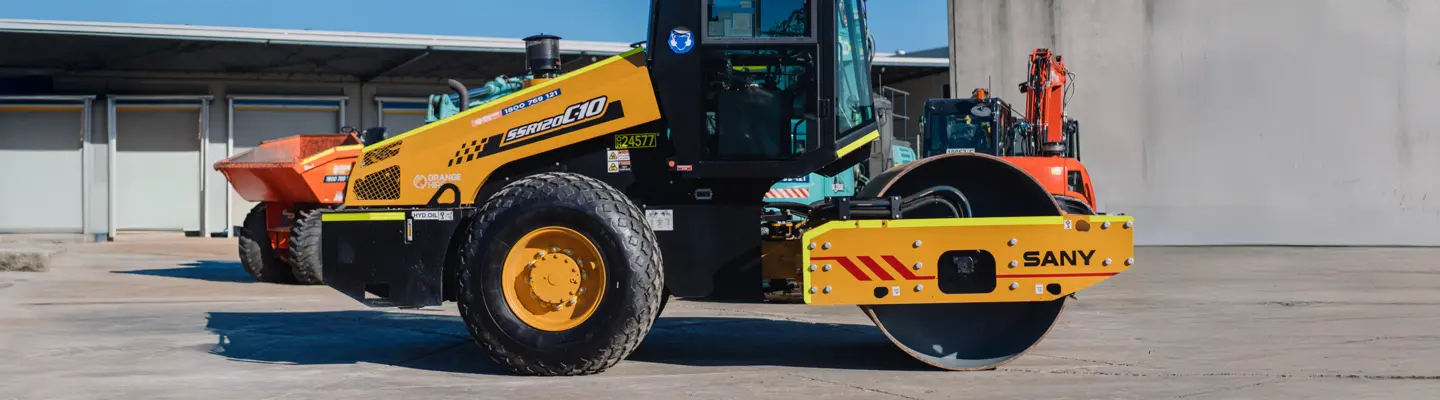
Laying the Right Foundations
No matter what kind of project you’re working on - from laying a foundation or compacting road base to backfilling a trench - good compaction is what keeps everything solid. It’s the unseen work that ensures strength, stability, and durability, preventing cracks, uneven settlement, or future repair jobs.
As Australia’s largest dry hire specialist in earthmoving gear, United Rentals has one of the country’s most comprehensive fleets of compaction rollers and equipment. Every machine is maintained to high safety standards and ready to perform across a wide range of soil conditions and project sizes.
In this article, we’ll cover:
- Why compaction matters in construction
- The different types of compaction equipment and when to use each one
- Key safety and compliance guidelines
- Practical site tips for achieving the best compaction results
- How United Rentals supports your project from start to finish
Why Compaction Is So Important
Compaction is simply the process of removing air pockets from soil, gravel, or asphalt so that the material becomes denser and more stable. A well-compacted base is essential for any structure - whether it’s a building, pavement, or drainage line - because it ensures long-term strength and prevents failure.
If compaction isn’t done correctly, it can lead to:
- Uneven settlement and structural instability
- Cracks and deformation in roads and pavements
- Poor drainage and water pooling
- Rework that adds time and cost to your project
That’s why choosing the right compaction equipment hire is critical for accuracy and efficiency on every site.
Types of Compaction Equipment and Their Uses
At United Rentals, you’ll find a full range of roller hire and compactor hire options, each designed to handle specific soil types and site conditions.
1. Trench Rollers – 1.5T Wacker Neuson Padfoot Trench Roller
Built for precision in confined spaces such as trenches or backfilled retaining walls.
- Key features: Remote-controlled operation for safety, adjustable compaction force, hydrostatic drive, and an articulated joint for better handling.
- Applications: Pipeline installation, backfilling, roadwork, and tight access sites.
2. Padfoot Rollers – 3T to 18T
The go-to choice for clay-heavy or cohesive soils. Their drum design “kneads” the material, compacting it more effectively than a smooth surface could.
- Models available: 3.3T, 8T, 12T, 15T, and 18T padfoot rollers.
- Best for: Earthworks, embankments, foundations, and large-scale civil projects.
3. Smooth Drum Rollers – 8T to 18T
Perfect for compacting granular soils and finishing asphalt. These rollers deliver high-density, uniform compaction across the surface.
- Models available: 8T, 12T, 15T, and 18T smooth drum rollers (including the Caterpillar CS663E).
- Best for: Road base preparation, unsealed road maintenance, rural driveways, and general construction work.
4. Twin Drum & Multi Tyre Rollers – 4T to 24T
Twin drum rollers are ideal for smaller areas and tight turns, while multi-tyre rollers apply consistent pressure for flexible pavement layers.
- Models available: 2.5T, 4T and 7T tandem rollers and 16T–24T multi-tyre rollers
- Best for: Road construction, footpaths, driveways, unsealed road maintenance, car parks, and asphalt finishing
Safety and Compliance Requirements
All compaction and roadwork activities in Australia must follow strict safety and compliance guidelines. These ensure that work is performed safely, efficiently, and to the required engineering standards.
Key Compliance Standards:
- AS 3798 – Guidelines on Earthworks for Commercial and Residential Developments: Defines testing and layer thickness requirements for consistent compaction.
- AS 4671 – Steel Reinforcing Materials: Ensures structural areas with compaction meet reinforcement standards.
- Safe Work Australia – Managing Risks of Plant in the Workplace: Covers machinery safety, guarding, and operator protection.
State-Specific Requirements:
- Transport for NSW (TfNSW) – governs roadwork compaction and traffic control in NSW state owned roads.
- Department of Transport and Main Roads (TMR QLD) – certifies equipment and plant use in Queensland state owned roads.
- VicRoads (Sections 204 & 205) – sets compaction and field testing only on Victoria state owned roads.
Working with a trusted hire partner like United Rentals ensures your equipment meets all relevant Australian and state-based standards, helping you maintain compliance and site safety at all times.
Tips for Getting Compaction Right
- Choose the right machine: Padfoot rollers for cohesive soils, smooth drum rollers for granular material.
- Compact in thin layers: 150–300mm layers help achieve even density throughout.
- Watch the moisture: Optimal moisture content makes compaction faster and more effective.
- Test your results: Use field density testing to confirm compaction quality.
- Stay safe: Always work on stable ground and keep your crew clear of operating zones.
The United Rentals Advantage
When you partner with United Rentals, you’re not just hiring machinery - you’re gaining a team that understands safety, performance, and productivity.
You’ll get:
- Equipment is maintained to national compliance standards.
- Specialist advice on the right compactor or roller for your job.
- Flexible short- and long-term hire options.
- 24/7 support to keep your project on track.
Whether you’re after roller hire, compaction equipment rental, or plate compactor hire, United Rentals has what you need - backed by expert service and the reliability of Australia’s largest dry hire specialist.
Ready to Get Started?
For more information about our complete range of compaction services and equipment, visit your nearest branch, email [email protected], or call our friendly team of experts at 1800 UR HIRE.
 Facebook
 X
 Linkedin
 Email
 Print
 Copy Link
 RSS Feed